Action Desk
Shared and internal resolution threads with live SLA clocks, bilateral collaboration, and clear ownership so blockers do not drag on.
Private Rollout Program
Partnerships do not fail from lack of effort. They fail from lack of shared understanding. Resolved Intent gives both sides one bilateral workspace to move from friction to shared resolution.
Every partner. Every blocker. Every initiative. Both sides see the same reality.
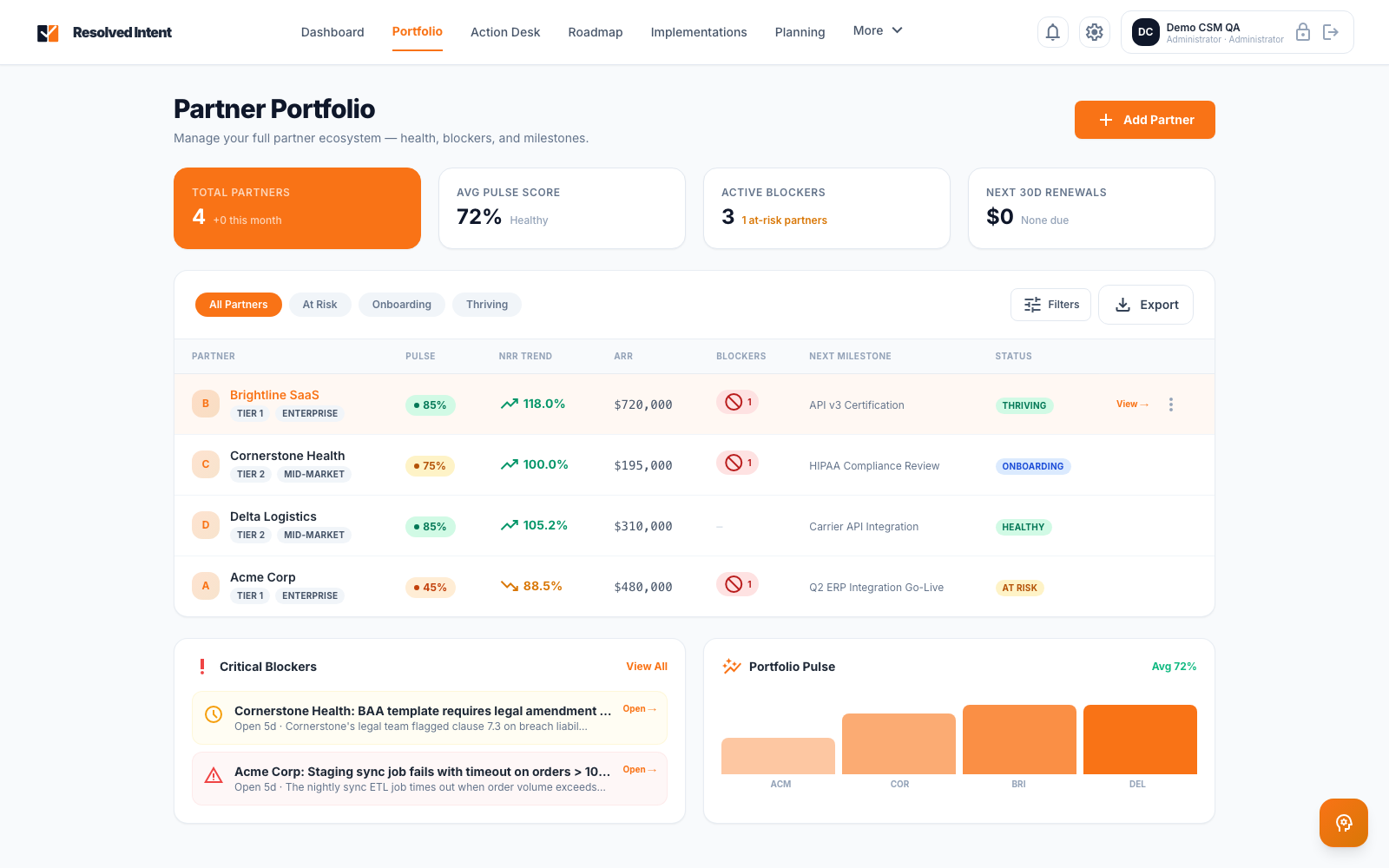
By the time an account flags as "at risk," the damage is already done.
Most teams are not short on data. They are short on shared understanding.
Partners submit tickets hoping someone gets the why. CSMs chase context across Slack, QBR notes, and handoffs. Resolved Intent turns that into one bilateral flow: Friction -> Initiative -> Milestone -> Resolution.
Apply
Fill out the short form. Takes 2 minutes. No deck required.
Founder call
20-minute call to understand your stack, teams, and rollout constraints.
Guided rollout
Onboarded together. Live in your environment. We work side-by-side with your team through first resolution.
From risk insight to owner action, both sides work from the same truth.
Shared and internal resolution threads with live SLA clocks, bilateral collaboration, and clear ownership so blockers do not drag on.
AI maps recurring friction into structured initiatives with phases, success criteria, and Partner, Customer, or Joint ownership.
Relationship intelligence across contacts, blockers, friction, initiatives, contracts, activity, and embedded agreements.
AI article generation, URL/PDF imports, Zendesk/Freshdesk ingestion, and partner enablement tracks.
Decision-ready risk briefs with evidence, ARR proxy exposure, and 48-hour actions for internal operators.
Proactive risk and stale-blocker digests that surface priority accounts before escalations.
From bilateral portfolio visibility to shared resolution threads and executive reporting.
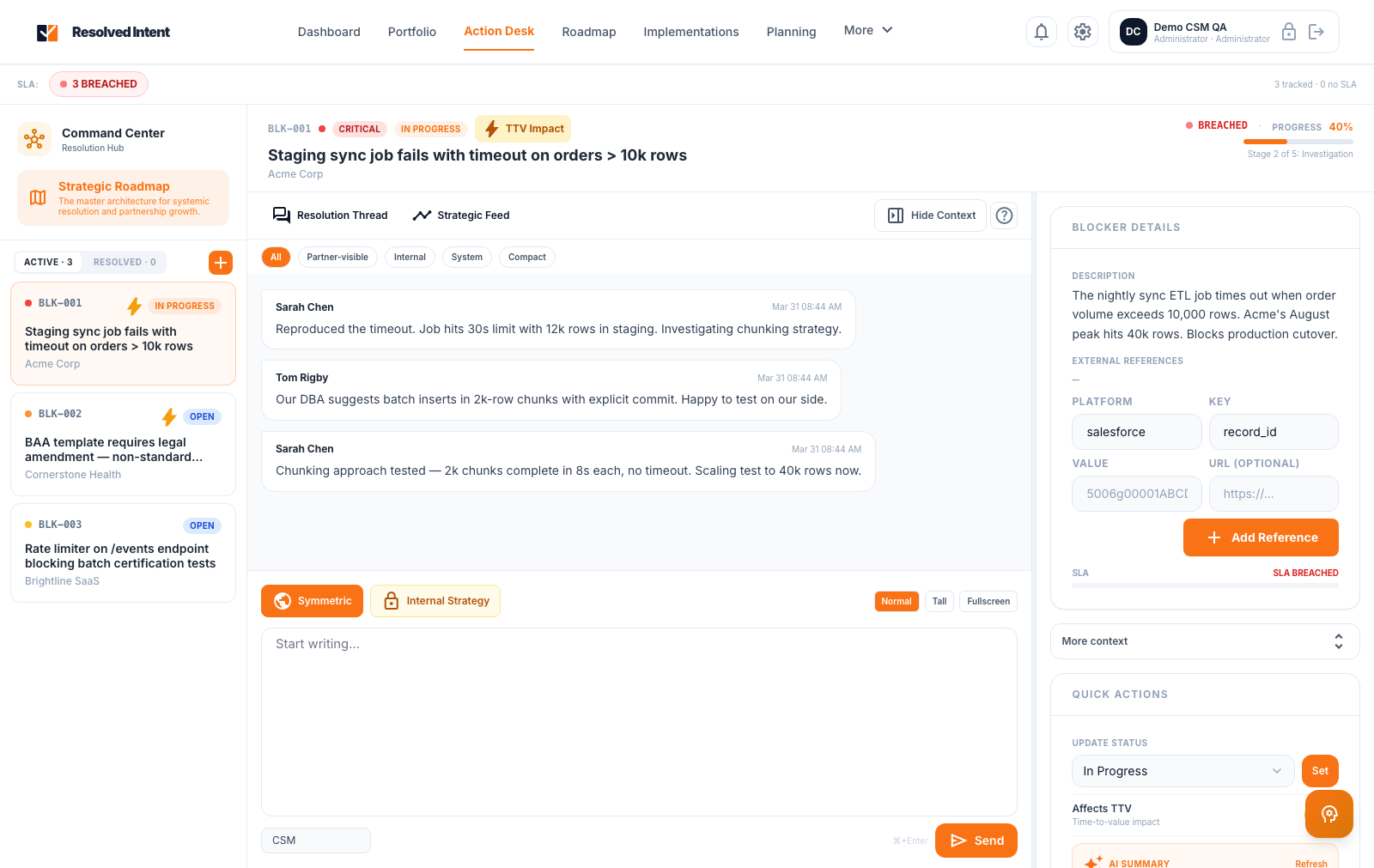
Action Desk
Bilateral resolution thread with SLA and closure accountability.
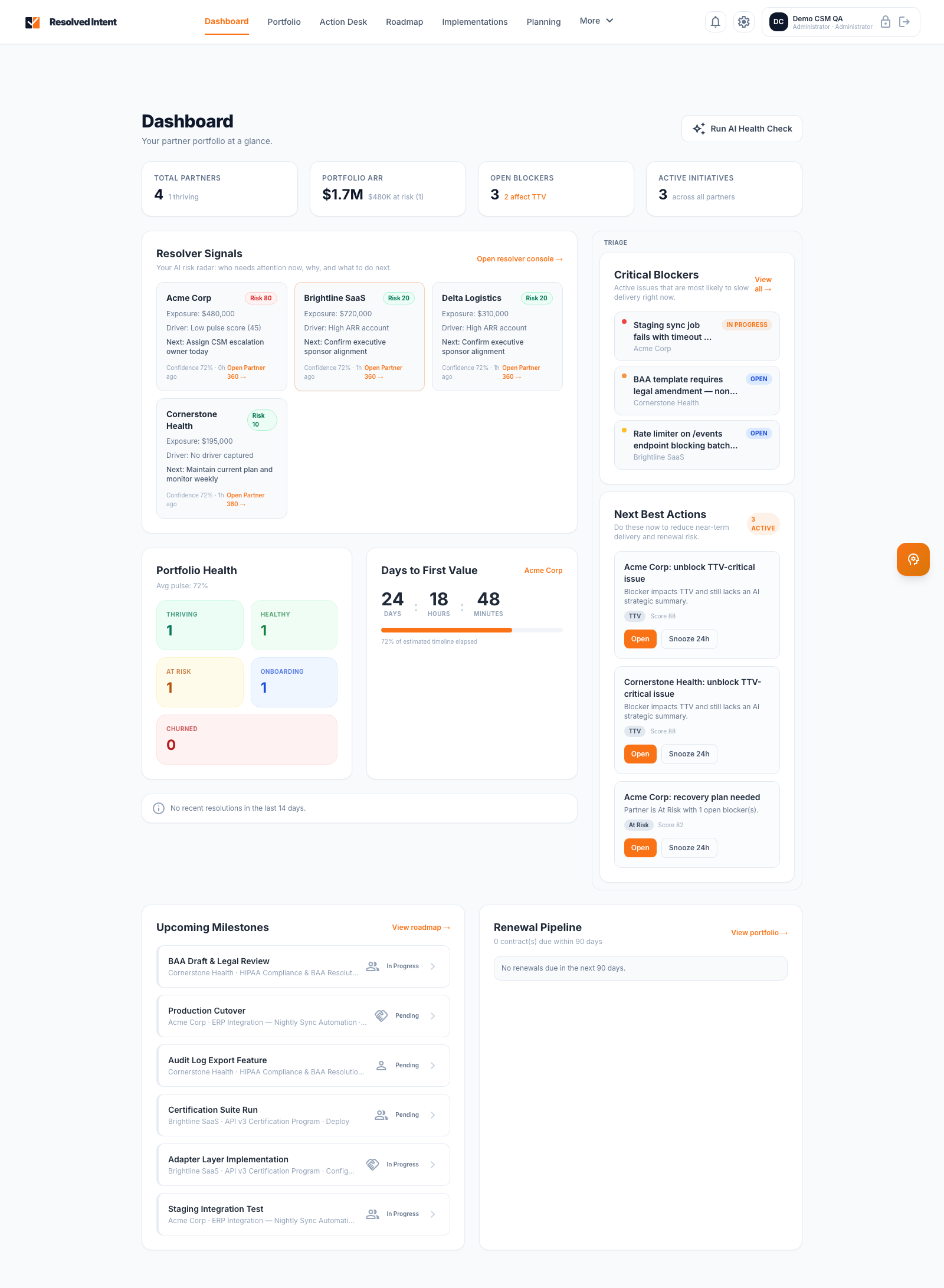
Executive Dashboard
Risk detection, renewal pressure, and next-best-actions in one view.
Operator outcome
Faster blocker resolution cycles
Executive outcome
Clear renewal and TTV risk signal
Partnership outcome
Shared context instead of ticket ping-pong
During private rollout we establish baseline metrics in week one and review progress with your leadership team every week.
Time-to-resolution
—
Avg. days from blocker open to first mutual resolution action. Baseline established at intake; updated as your rollout progresses.
Renewal risk visibility
—
% of at-risk accounts surfaced before quarterly review. Based on engagement signals we establish at intake.
Cross-team alignment
—
Shared blocker visibility score between vendor and partner. Tracks context fragmentation from day one.
Best fit
VP CS / CCO at B2B SaaS
Teams managing partner implementations, blockers, and renewal risk across multiple stakeholders.
Core outcome
Faster unblock velocity
Shorten blocker cycles by giving both sides one shared operational source of truth.
Why now
Renewals are won in execution
When context is fragmented, trust erodes. Shared visibility is no longer optional.
Teams looking for a self-serve SaaS product with no rollout support.
Companies with fewer than 3 people managing partner or customer relationships.
Organizations that consider partner success a back-burner initiative.
Teams that only want reporting dashboards without changing how work gets done.
This is a hands-on bilateral operating system. It works when CS leaders are ready to change how their teams and partners coordinate execution.
Resolved Intent runs as a dedicated tenant in our cloud environment. All data is encrypted in transit and at rest. Authentication uses session-based auth with role-based access controls (RBAC). SSO via SAML/OIDC is on our roadmap — we share specific timing during rollout consultation.
At launch: Slack and Microsoft Teams (event delivery webhooks), Jira and Linear (external reference links), and Salesforce (account scaffolding with deep-link support). Bidirectional sync with Jira and Salesforce — including OAuth-based connection — is on our roadmap. We share specific timing during rollout consultation.
Most private rollout teams are operational within the first week. Full rollout timeline depends on your partner count, existing stack, and how quickly your teams can align on blocker intake workflows. We share a concrete estimate during consultation — and hold ourselves to it.
Yes. We don't require you to replace your CRM or project management tool. Resolved Intent sits alongside your existing stack and becomes the bilateral execution layer. During onboarding, we work with you directly to map your existing blocker context and build out your initial workspace — no import tooling required.
Pricing is tailored by partner count, workflow scope, and onboarding depth. We align on rollout pricing during the consultation call so there are no surprise costs.
Private Rollout Access
This is a hands-on rollout with direct access to the product team. We're looking for CS leaders who want to replace one-sided workflows with bilateral execution.
Step 1: request access. Step 2: immediately book your rollout consultation.
No spam. Qualified teams only. One scheduling follow-up at most.